
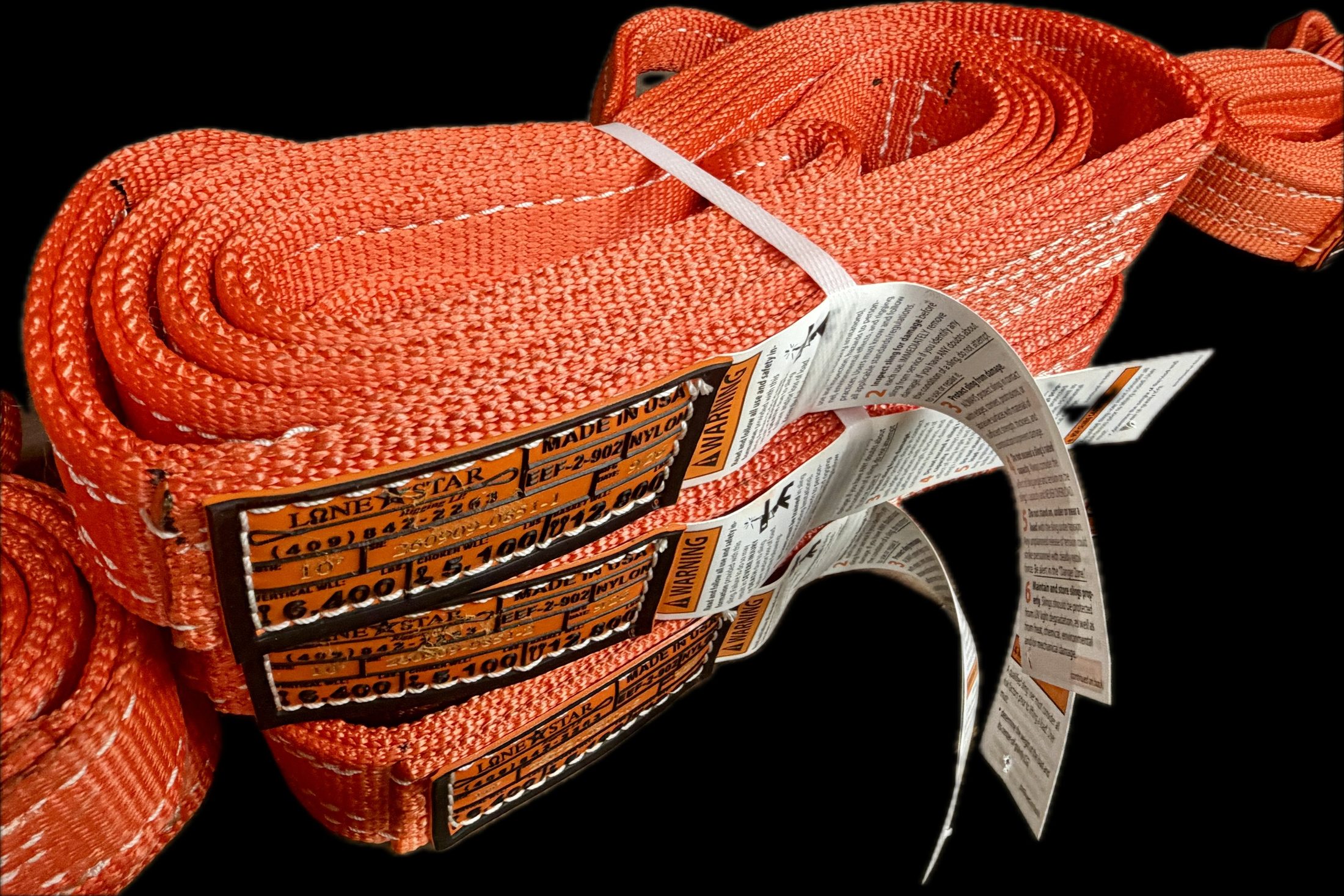
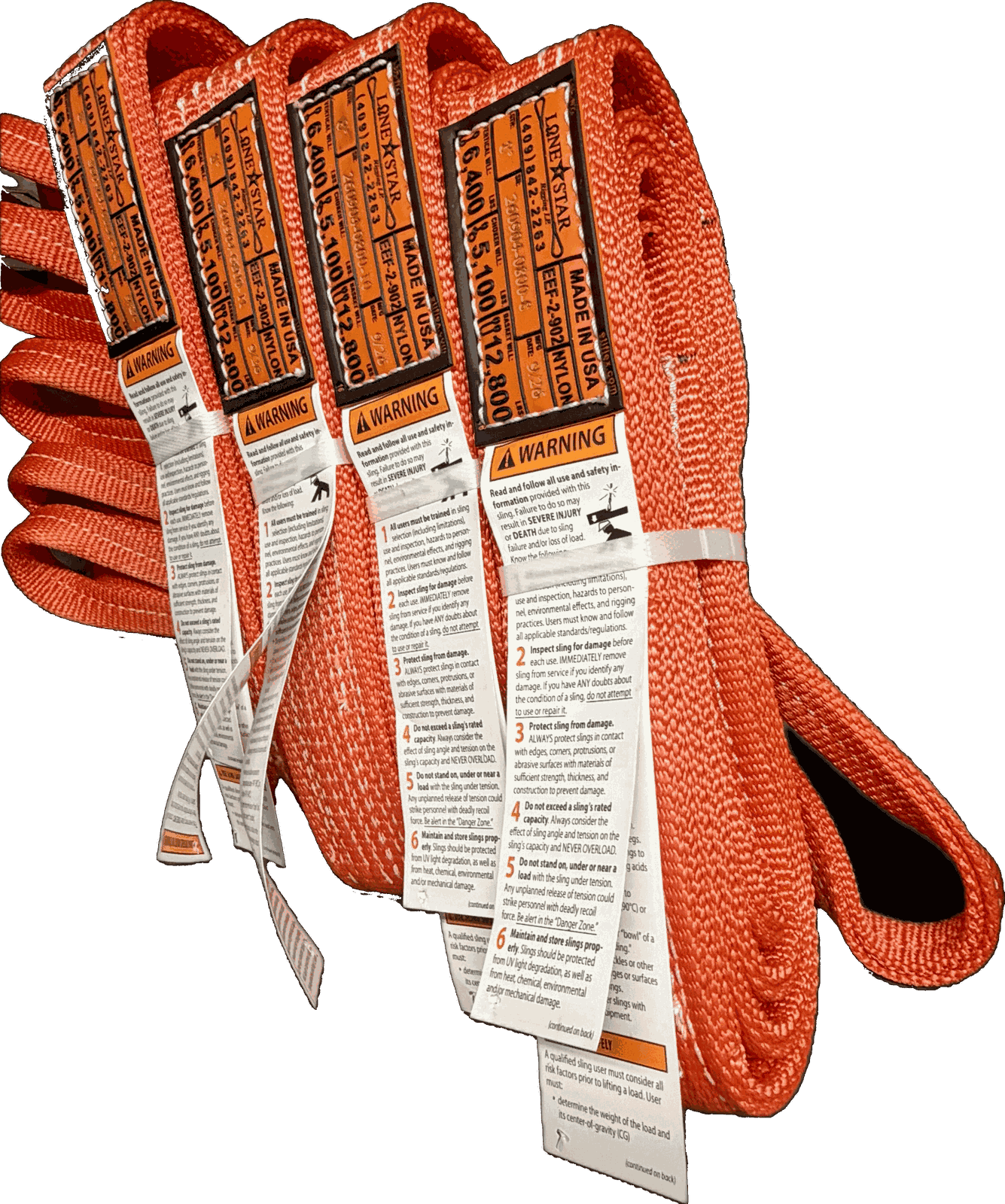
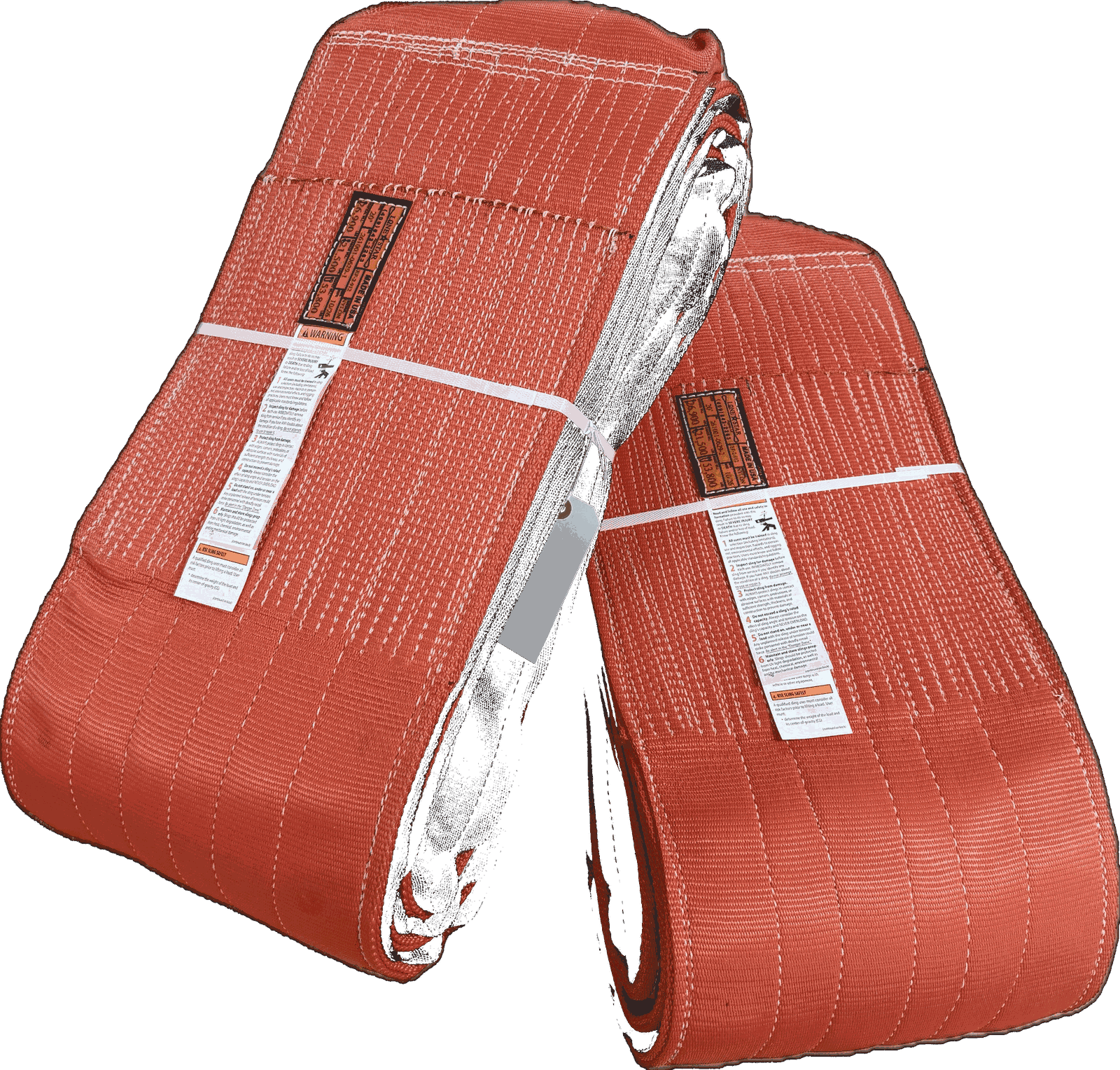
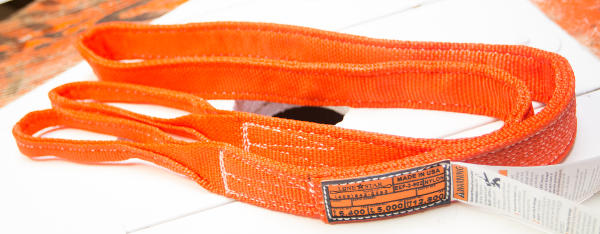
| Eye & Eye 9800lb Web Slings | |||||||
|---|---|---|---|---|---|---|---|
| Rated Capacity – LBS | |||||||
| Sling Width | Number of Plys | Vertical | Choker 120° | Basket Hitches | |||
| Basket Hitch Legs 90° | Bridle Hitch 60° | Bridle Hitch 45° | Bridle Hitch 30° | ||||
| 1" | 1 | 1,600 | 1,300 | 3,200 | 2,800 | 2,300 | 1,600 |
| 2" | 1 | 3,200 | 2,600 | 6,400 | 5,500 | 4,500 | 3,200 |
| 3" | 1 | 4,800 | 3,800 | 9,600 | 8,300 | 6,800 | 4,800 |
| 4" | 1 | 6,400 | 5,100 | 12,800 | 11,100 | 9,000 | 6,400 |
| 6" | 1 | 9,600 | 7,700 | 19,200 | 16,600 | 13,600 | 9,600 |
| 8" | 1 | 12,800 | 10,200 | 25,600 | 22,200 | 18,100 | 12,800 |
| 10" | 1 | 16,000 | 12,800 | 32,000 | 27,700 | 22,600 | 16,000 |
| 12" | 1 | 19,200 | 15,400 | 38,400 | 33,300 | 27,100 | 19,200 |
| 1" | 2 | 3,200 | 2,600 | 6,400 | 5,500 | 4,500 | 3,200 |
| 2" | 2 | 6,400 | 5,100 | 12,800 | 11,100 | 9,000 | 6,400 |
| 3" | 2 | 8,900 | 7,100 | 17,800 | 15,400 | 12,600 | 8,900 |
| 4" | 2 | 11,500 | 9,200 | 23,000 | 19,900 | 16,300 | 11,500 |
| 6" | 2 | 16,300 | 13,000 | 32,600 | 28,200 | 23,000 | 16,300 |
| 8" | 2 | 20,500 | 16,400 | 41,000 | 35,500 | 29,000 | 20,500 |
| 10" | 2 | 24,000 | 19,200 | 48,000 | 41,600 | 33,900 | 24,000 |
| 12" | 2 | 26,900 | 21,500 | 53,800 | 46,600 | 38,000 | 26,900 |
| 1" | 3 | 4,100 | 3,300 | 8,200 | 7,100 | 5,800 | 4,100 |
| 2" | 3 | 8,200 | 6,600 | 16,400 | 14,200 | 11,600 | 8,200 |
| 3" | 3 | 12,300 | 9,800 | 24,600 | 21,300 | 17,400 | 12,300 |
| 4" | 3 | 15,300 | 12,200 | 30,600 | 26,500 | 21,600 | 15,300 |
| 6" | 3 | 22,900 | 18,300 | 45,800 | 39,700 | 32,400 | 22,900 |
| 8" | 3 | 30,700 | 24,600 | 61,400 | 53,200 | 43,400 | 30,700 |
| 10" | 3 | 36,000 | 28,800 | 72,000 | 62,400 | 50,900 | 36,000 |
| 12" | 3 | 40,300 | 32,200 | 80,600 | 69,800 | 57,000 | 40,300 |
| 1" | 4 | 5,500 | 4,400 | 11,000 | 9,500 | 7,800 | 5,500 |
| 2" | 4 | 11,000 | 8,800 | 22,000 | 19,100 | 15,600 | 11,000 |
| 3" | 4 | 16,500 | 13,200 | 33,000 | 28,600 | 23,300 | 16,500 |
| 4" | 4 | 20,400 | 16,300 | 40,800 | 35,300 | 28,800 | 20,400 |
| 6" | 4 | 30,600 | 24,500 | 61,200 | 53,000 | 43,300 | 30,600 |
| 8" | 4 | 41,000 | 32,800 | 82,000 | 71,000 | 58,000 | 41,000 |
| 10" | 4 | 48,000 | 38,400 | 96,000 | 83,100 | 67,900 | 48,000 |
| 12" | 4 | 53,700 | 43,000 | 107,400 | 93,000 | 75,900 | 53,700 |
Take a load off our mind.
If you’re looking for a full line of proven synthetic web slings for your many different loads, you’ve come to the right place.
Information to help you fit web slings to your application.
On these pages, you’ll find how to match the sling to your load according to rated capacity, how to use the right hitch, how to calculate the load on each leg of a sling and how to adjust the rated capacity of choker hitches. You’ll also find out how to choose the right material, coatings and wear pads to fit your many different lift requirements.
One of the industry’s most complete lines of synthetic web products.
One size does not fit all. Our complete line of synthetic web products includes:
- Heavy-duty web sling products in 10 standard types.
- Web products for special needs such as boat lifting applications, truck tiedowns and many others.
- NanoTech round slings.
- Custom-made web products to fit your unique needs.
- Specifications on the hardware you’ll need.
Details on proper care and maintenance.
Read how to care for and maintain your web slings. See the special sections within this handbook on troubleshooting, proper inspection, cleaning and storage to help you make the most of your web sling investments.
Proven experience in technical and sales support.
Nobody else has more experience in the lifting industry than we do. Look to us for engineering assistance in sling selection and design, including experience in high-capacity, multiple-sling rigging systems. We also offer expert technical sales support at the local level. Call us today, and we’ll help you take a load off your mind.
Why proper cleaning is vital.
All it takes is a little ordinary dirt, grit and grime to reduce the overall strength and life of your sling. It’s very easy for these contaminants to penetrate between fibers anytime the webbing bends, pulls tight against loads, or stretches and relaxes during loading and unloading. Once in place, they grind against the fibers, reducing their strength and useful life.
That’s why it’s a good idea to properly store your slings when they’re out of service and to clean them when they become soiled. When slings are clean, they’re not only easier to inspect, they’re also stronger and more durable.
There are many procedures you can use to clean your slings, depending on how soiled they are. For everyday dirt and grime, you can clean with soap or detergent and water for good results. Whatever cleaning method you use, always hang your washed slings in a dry, sheltered place. Always keep slings from prolonged contact with direct sunlight during drying and storage because ultraviolet rays can degrade synthetic fibers. Nylon or polyester slings that have been dyed any color but white will fade somewhat due to washing, but this in no way affects the strength of the webbing.
Both nylon and polyester webbing have an extremely low water absorption rate, making them flexible, light and easy to handle even after prolonged soaking in water. Both also show excellent resistance to mold, mildew and fungus, although dirt that accumulates on slings may support their growth, and that’s why regular cleaning is very important.
Choose the right hitch for your load.
By using the following descriptions, you’ll ensure the right choice when selecting a hitch for your various lifting operations.

Vertical.
Also called straight hitches. These attach by simply using a sling to connect a lifting hook to a load. Use the sling to its full rated lifting capacity, but never above it. Use a tagline to keep the load from rotating, which may damage the sling. When you attach two or more slings to the same lifting hook, the total hitch becomes a lifting bridle, distributing the load among the individual slings. When using two or more slings, remember that the sling angle affects the slings’ rated capacities.

Choker.
These hitches are used when the load won’t be seriously damaged by the sling body (or vice versa) and when the lift requires the sling to hug the load. These reduce a sling’s lifting capability. The diameter of the bend where the sling contacts the load should keep the point of choke against the sling body — never against a splice or the base of the eye. When a choke is used at an angle of less than 120°, the sling rated capacity must be reduced.
Two notes of caution: always pull a choker hitch tight before a lift is made — not during the lift. And never use only one choker hitch to lift a load that may shift or slide out of the choke.

Basket.
These hitches distribute a load between the two legs of a sling within the limitations described below.
Calculate the load of basket hitches.
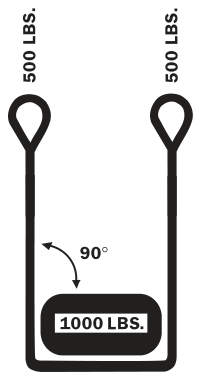
There’s an important principle to remember before you calculate your load: as the horizontal angle of a sling decreases, the load on each leg increases. That’s true whether you use a single sling as a basket or two slings with each in a straight pull such as a two-legged bridle.
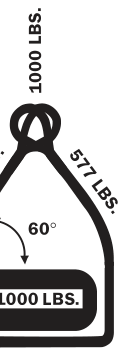
Example 1
- Total load is 1,000 lbs. divided by two legs = 500 lbs. (load per leg if vertical lift).
- Horizontal sling angle is 60°.
- Multiply 500 lbs. by 1.154 load factor (from table) = 577 lbs. actual load per leg.
Example 2
- Total load is 1,000 lbs. divided by two legs = 500 lbs. (load per leg if vertical lift).
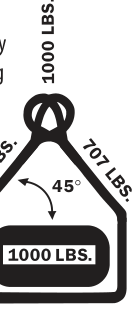
- Horizontal sling angle is 45°.
- Multiply 500 lbs. by 1.414 load factor (from table) = 707 lbs. actual load per leg.
Example 3
- Two-leg total load is 1,000 lbs.
- Horizontal sling angle is 30°.
- Multiply by 2 and actual load is 1,000 lbs.
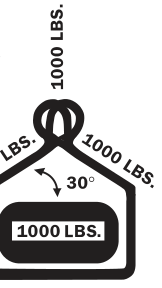
Anytime you lift a load with a leg (or legs) of a sling at an angle, you can calculate the load per leg as well as the sling’s rated capacity by using the following three-step formula.
- Divide your total load by the number of legs you’re using. This gives you the load per leg if the lift were being made with all legs lifting vertically. All of these calculations assume the center of gravity is directly below the hook. If not, then more complicated engineering calculations are needed.
- Find out the angle between the legs of the sling and the horizontal plane.
- Multiply the load per leg (from step 1) by the load factor for the leg angle you’re using (from the table). This gives you the actual load on each leg for this lift and angle. The actual load must never exceed the sling’s rated capacity.
Calculating the angle of bridles.
The horizontal angle of bridles with three or more legs is measured the same way as horizontal sling angles of two-legged hitches. If a bridle is designed with different leg lengths, it may result in different horizontal angles. Normally, the leg with the smallest horizontal angle will carry the greatest load. That means you should use the smallest horizontal angle when you calculate the actual leg load and evaluate your sling’s rated capacity. In extreme angular conditions, an engineering analysis should be made.
| Leg angle | Load factor |
|---|---|
| 90° | 1.000 |
| 85° | 1.003 |
| 80° | 1.015 |
| 75° | 1.035 |
| 70° | 1.064 |
| 65° | 1.103 |
| 60° | 1.154 |
| 55° | 1.220 |
| 50° | 1.305 |
| 45° | 1.414 |
| 40° | 1.555 |
| 35° | 1.743 |
| 30° | 2.000 |
Adjusting choker hitch rated capacity.
When a choker hitch is drawn tight at an angle of less than 120°, you’ll need to reduce the hitch’s rated capacity to allow for loss of rated capacity as the chart below shows.
| Angle of choke | Rated capacity* |
|---|---|
| 120°–180° | 100% |
| 60°–119° | 95% |
| 0°–59° | 90% |
* Percent of sling’s rated capacity in a choker hitch.
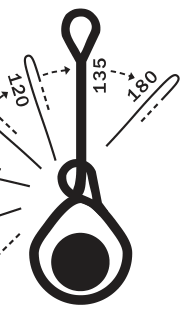
Our tests have shown that when the angle was less than 120°, the sling body always failed at the point of choke when pulled to maximum. You must always allow for this anytime you use a choker hitch to shift, turn or control a load, or when the pull is against the choke in a multi-leg lift.